

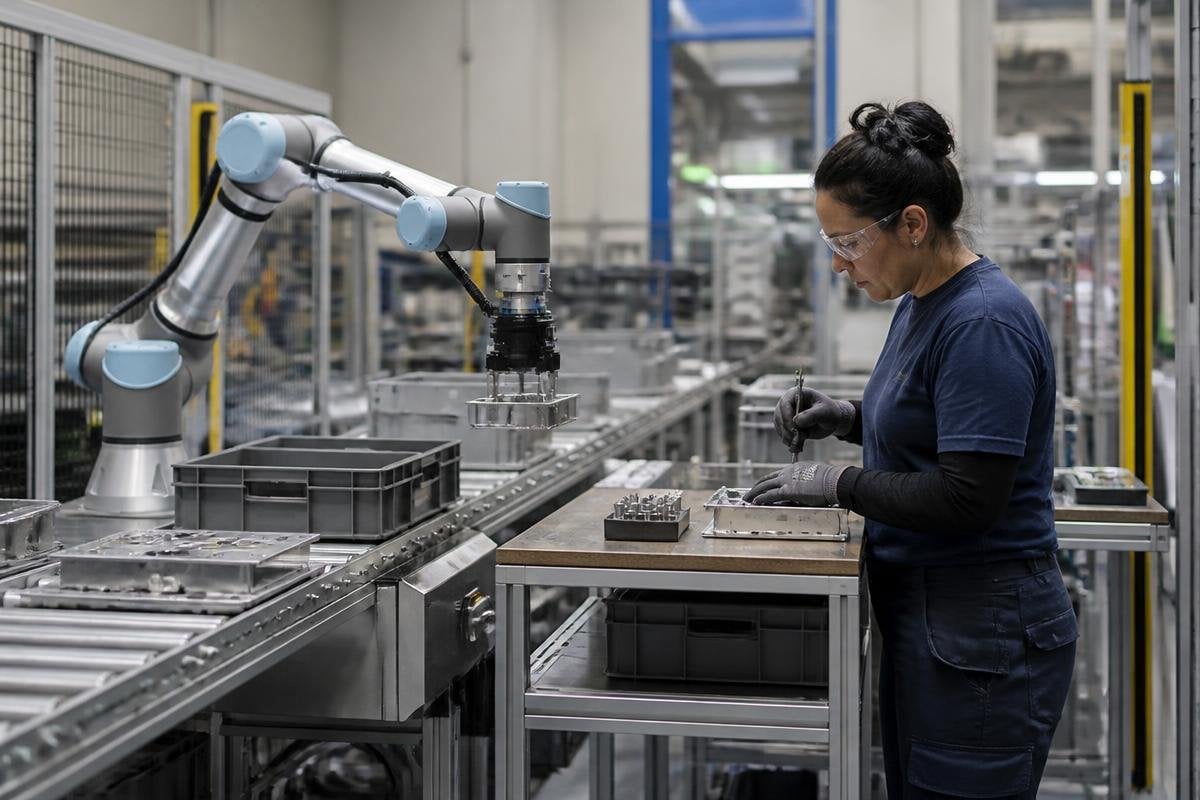
Robots can carry parts all day, while a technician handles checks, changes, and faults that need judgment. The next factory teams will work well when each side has a clear job, a safe handoff, and a way to stop the process.
- Robots take repeatable loads and motions
- People handle exceptions, quality checks, and repairs
- The handoff needs sensors, rules, and training
Start with the task, not the robot
A factory team should begin with one task that has a clear input and output. The robot might move a tray between a conveyor and a workbench, hold a part while a technician fastens it, or feed components into a test fixture.
That narrow start matters because the team can measure the work. Check cycle time, error rate, operator steps, and the number of times someone has to stop the cell. A wider project makes those results harder to read.
The robot also needs a defined operating area. A work cell can use a safety scanner to detect a person near the robot, while a guard or light curtain can stop motion at a set point. The exact layout depends on the robot, the tool, the part, and the task.
A collaborative robot, often called a cobot, is built for work near people. That label doesn’t remove the need for a risk check. The gripper, part edges, speed, force, and surface around the cell can all change the hazard.
The handoff is the hard part
Human-robot work depends on timing. The robot needs to know when a part is ready, when a person has finished a step, and when the next motion can begin. A sensor, button, barcode, or signal from the factory control system can provide that state.
The message must be clear to the operator. A light can show that the robot is waiting for a part. A screen can show why the cell stopped. An audible warning can help when the person is looking at the workpiece instead of the robot.
The physical handoff needs the same care. An arm that places a part too close to a person’s hand creates extra risk and slows the job.
A fixture that holds the part in one repeatable position gives the person a better chance to work without reaching across moving equipment.
A factory manager comparing automation projects needs dated evidence from working plants, not a clean demo. Robot24.com robotics coverage can connect a machine’s task, site, and limits to the team plan before the next section looks at the exceptions people still handle.
People still own the exceptions
Programmed limits shape what the robot can do. It can pause when a sensor sees an object, but a person may need to decide whether that object is a damaged part, a tool, or a loose cable. That decision belongs in the work plan before the cell runs.
Training should cover three moments: normal operation, a stopped cell, and a fault that needs technical help. Workers need to know where the stop control is, what the status signals mean, and who can reset the system.
The factory also needs a record of changes. A new part, gripper, software setting, or conveyor position can change the risk. The person who approves that change should check the task again and update the instructions.
Data can help the team find weak points. Count blocked sensors, failed grasps, manual resets, and missed handoffs. Those counts show where the robot needs a better fixture, a new sensor, or a different job.
A practical planning checklist
Use these points before choosing equipment or changing a work cell:
- Name the exact task and the person who owns each step.
- Mark where the robot moves, waits, and hands over a part.
- Choose the signal that tells each side the work is ready.
- Test the stop controls with the cell empty and loaded.
- Record faults, manual resets, and damaged parts during a trial.
- Set a date to review the cell after the first production change.
I’d keep the first team small and measurable. A robot moving parts beside one trained operator can teach more than a large plan with unclear jobs.
The useful measure is the handoff: how often it works, how often a person must intervene, and how safely the cell returns to work after a stop. Those results will decide which tasks join the team next.
