
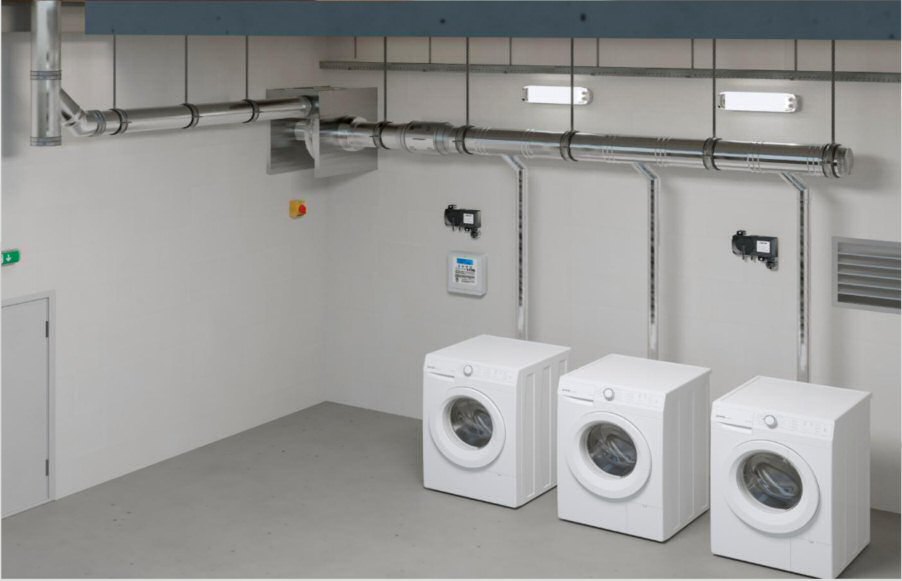
An interior laundry room offers design flexibility, but its location can make dryer exhaust planning more difficult. The duct may need to travel through walls, ceilings, or floor cavities before reaching an exterior termination. When this route creates more resistance than the dryer can manage, a listed dryer vent fan may be used to support exhaust airflow. The entire vent layout should be assessed before selecting or installing the equipment.
Why Are Interior Laundry Rooms More Difficult to Vent?
A laundry room positioned beside an exterior wall can often use a short, direct exhaust route. An interior room may require a much longer duct with several changes in direction.
Every foot of duct and each elbow adds resistance to airflow. As resistance increases, the dryer’s internal blower must work harder to push warm, moist air outdoors. If the route becomes too restrictive, drying performance may decline.
Interior locations can also make the duct harder to access. Sections may be concealed above ceilings or behind finished walls, making future inspection and cleaning more complicated. The route therefore needs to be planned around both airflow and service access.
How Does the Exhaust Route Affect Dryer Performance?
A dryer needs steady airflow to remove heat, moisture, and lint from the drum. A short and smooth metal duct generally creates less resistance than a long duct with several elbows.
Long or restrictive routes may contribute to:
- Longer drying cycles
- Damp clothes after a normal cycle
- Excess heat around the appliance
- Weak airflow at the exterior termination
- Moisture remaining in the exhaust system
- Lint accumulating inside the duct
- Higher energy use from repeated drying cycles
The dryer manufacturer typically states a maximum permitted vent length. Elbows reduce that allowance because they create additional resistance. Installers should calculate the equivalent length rather than measuring only the straight sections.
When Might a Powered Fan Be Needed?
A powered dryer exhaust fan may be considered when the planned route exceeds the length the dryer manufacturer allows and the duct cannot be shortened or straightened.
These situations may occur in:
- Multistory homes
- Apartments and condominiums
- Interior utility rooms
- Finished basements
- Large home additions
- Remodeling projects with limited exterior access
- Buildings where structural elements restrict duct routing
Before adding a fan, contractors should determine whether the route can be improved. Moving the termination, reducing the number of elbows, or selecting a more direct path may lower resistance without introducing another mechanical component.
If powered assistance is still required, the chosen unit should be specifically listed for dryer exhaust applications. A general-purpose duct fan may not be suitable for the heat, humidity, and lint carried by dryer exhaust.
What Makes a Good Dryer Vent Layout?
The preferred route is short, direct, and accessible. Smooth-wall metal duct helps reduce resistance and provides a suitable surface for lint removal. Excess flexible transition material should be avoided, especially in concealed sections.
Installers should also limit unnecessary elbows. When a turn is required, a gradual fitting can support better airflow than an abrupt change in direction.
Joints should be secured and sealed using methods permitted for dryer exhaust ductwork. Fasteners that project into the airflow path can catch lint and create collection points. The duct should also be protected from crushing or physical damage.
The termination must discharge outdoors. Dryer exhaust should not empty into an attic, crawl space, wall cavity, garage, or other enclosed area. The exterior hood should open freely during operation without allowing pests, debris, or weather to obstruct the duct.
How Should a Dryer Vent Fan Be Selected?
Fan selection should begin with the duct diameter and calculated equivalent length. Contractors should review the product’s supported duct length, operating temperature, activation method, mounting requirements, and electrical specifications.
Useful selection factors include:
- Compatibility with the dryer duct size
- Listing for dryer exhaust use
- Maximum supported duct length
- Automatic activation method
- Delay or run-on operation
- Installation orientation
- Service access requirements
- Cleaning instructions
- Warning or status indicators
- Manufacturer placement requirements
The fan should activate when the dryer begins operating and stop when exhaust support is no longer required. Automatic control prevents occupants from needing to operate a separate wall switch during every drying cycle.
Where Should the Fan Be Installed?
The correct location depends on the fan design and manufacturer instructions. It should be placed far enough from the dryer to operate as intended while remaining accessible for service.
Access is especially important because dryer exhaust carries lint. A fan hidden permanently behind drywall cannot be cleaned, inspected, or replaced without opening the finished surface. Builders should plan an access panel or place the equipment in a serviceable mechanical area.
The unit and surrounding duct should be properly supported. Poor support can allow movement, vibration, or separation at the joints. Installers should also confirm that airflow follows the direction marked on the fan housing.
What Should Be Tested After Installation?
The complete system should be tested with the dryer operating. The fan must start as intended, and the exterior termination flap should open freely. Airflow should be checked at the outlet, while duct connections should be inspected for leaks or unusual vibration.
The dryer should also complete a normal cycle without overheating or producing warning messages. If performance remains poor, the installer should reassess the duct for hidden restrictions, incorrect fan placement, or appliance-related problems.
Home inspectors and energy auditors can note the presence of powered exhaust equipment and verify whether it is accessible. They can also recommend further assessment when the fan fails to activate or when airflow at the exterior outlet appears weak.
Why Does Ongoing Maintenance Matter?
A powered fan does not eliminate the need for regular dryer vent cleaning. The lint screen should be cleaned after each load, while the transition duct, fixed exhaust duct, fan, and exterior termination should be inspected periodically.
Drying times that gradually increase may signal lint buildup or another restriction. A sudden change may indicate a disconnected duct, damaged termination, failed control, or fan malfunction.
Planning for service access from the beginning makes this maintenance easier and reduces the risk of concealed problems. For listed dryer booster fan kits designed to support long exhaust runs, visit Suncourt and compare options based on duct size, route length, activation method, and installation requirements.